
Key takeaway
Quick answer: is a brown lawn dead?
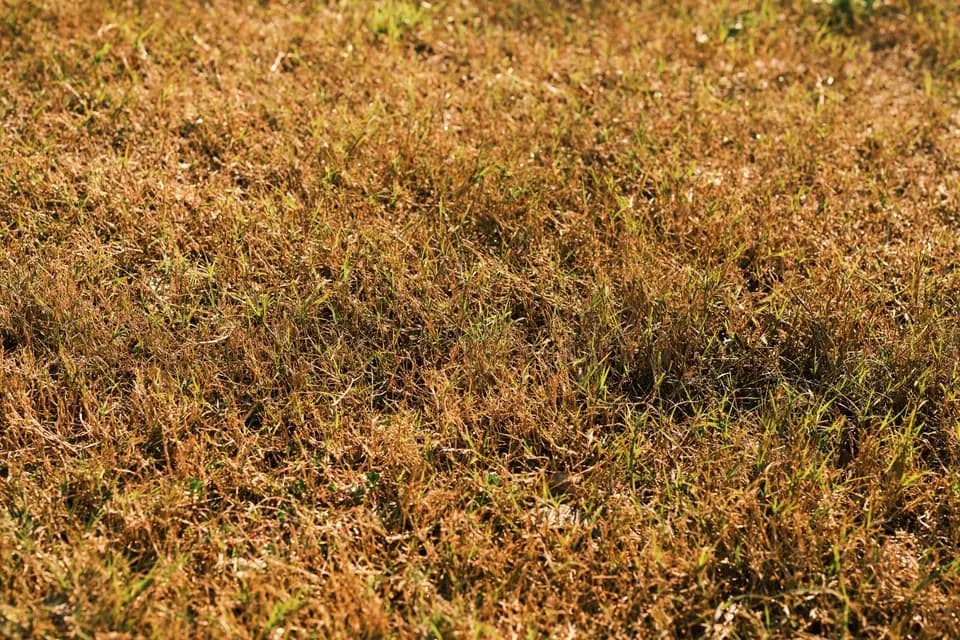
Usually not. Grass survives drought by going dormant: it shuts down top growth and protects the crown at soil level. A dormant lawn normally greens up within two to three weeks of sustained rain, with no work needed. The real repair job, scarifying and overseeding, should wait until September when the soil is warm and the rain is reliable.
After a long hot spell, half the gardens in Lincoln go the colour of straw and the phone starts ringing about dead lawns. Almost none of them are dead. Grass is much tougher than it looks in August, and the biggest mistake people make is trying to fix it in the middle of the heat, which usually causes more damage than the drought did.
Here is how to tell whether your lawn is dormant or genuinely dead, what to do while it is still hot, and the right way to bring it back in autumn.
Is your lawn dead or just dormant?
There is a simple test. Grab a handful of the brown grass and pull firmly.
- If it resists and the roots hold in the soil, the lawn is dormant and alive. It will recover on its own once the rain returns.
- If it lifts away easily with no root attached, that patch has died and will need reseeding.
- Look at the crown too, the pale swollen base of each plant at soil level. If it is still firm and whitish rather than shrivelled and brown, the plant is alive.
Another clue is the pattern. Drought browning is usually broad and even, worst on south-facing slopes, thin soil, and the strip along a path or driveway where the ground bakes and holds least water. Dead patches from disease or pests tend to be irregular, sharply defined, and appear while the rest of the lawn is still green.
Garden Sorted, Start to Finish See Gardening Services or Get a Quote.
Why grass turns brown in hot weather
Dormancy is a survival mechanism, not a failure. Faced with drought stress, grass stops putting energy into leaf growth and protects the crown and roots instead. The leaves go straw coloured and growth stops, but the plant is alive and waiting. Most UK lawn grasses can hold that state for several weeks and still come back.
Some areas always go first: compacted ground where roots cannot get deep, thin soil over rubble or old builder's waste, sandy free draining patches, and anywhere in full sun all day. Those are the same spots worth improving in autumn, because they will be the first to brown off again next summer.
Brown patches on a lawn: drought, or something else?
Not every brown patch in summer is drought. If the rest of the lawn is coping and only certain areas have gone, it is worth checking what you are actually dealing with before you treat it.
Common causes of brown patches on UK lawns and how to tell them apart.
| What you see | Likely cause | What to do |
|---|---|---|
| Broad, even straw colour, worst in full sun, turf firm underfoot | Drought dormancy | Nothing. It recovers with rain |
| Patches with pink or reddish thread-like strands in the grass | Red thread, a common summer fungus | Usually linked to low nitrogen. Feed in autumn, improve airflow |
| Turf lifts like loose carpet, birds or badgers digging it up | Chafer grubs or leatherjackets | Check under the turf for grubs. Treat and repair in autumn |
| Small discrete rings, often with a darker green edge | Dog urine | Water the spot heavily, reseed the centre |
| Sharp straight-edged strips | Mower scalping on humps, or fuel or oil spill | Raise the mowing height, reseed the strip |
What to do while it is still hot
Do
- Raise the mower height and leave the grass longer, around 5cm, so it shades its own roots
- Mow less often, and not at all if the grass has stopped growing
- Water deeply once or twice a week rather than a light sprinkle daily, which encourages shallow roots
- Water early morning or evening so less is lost to evaporation
- Leave short clippings on the lawn as a light mulch to hold moisture
- Keep off it where you can, because foot traffic on dormant grass damages the crowns
Do not
- Do not apply a high nitrogen feed to drought stressed grass, it pushes growth the plant cannot support and can scorch it further
- Do not scarify or aerate a bone dry lawn, you will tear out living plants
- Do not scalp it short in the hope of tidying it up, short grass bakes faster
- Do not lay new turf or sow seed into dry soil in the middle of a hot spell
- Do not panic and dig it up. Give it until autumn before deciding anything is dead
Should you mow the lawn in a heatwave?
Only if it is actually growing. If the lawn has gone dormant and stopped putting on height, leave the mower in the shed. When you do cut, raise the blades, cut in the evening rather than the middle of the day, and never take more than a third of the leaf off in one go.
Watering, and what to do if there is a hosepipe ban
Deep and infrequent beats little and often. A light daily sprinkle wets the surface, encourages roots to stay shallow, and evaporates before it does much good. One or two proper soakings a week gets water down to where the roots are.
If a hosepipe ban is in force, save the plants and let the lawn go
Temporary use bans normally restrict hosepipes and sprinklers but still allow watering cans, though the exact rules vary by supplier so check yours. Either way, prioritise trees, shrubs and anything planted in the last year or two. A lawn will recover from a brown summer on its own. A dead shrub or a young tree is a replacement cost.
When to repair a scorched lawn: September is the month
Autumn is the best time to renovate a lawn in the UK, and early to mid September is close to ideal. The soil is still warm from summer so seed germinates quickly, rainfall is more reliable so you are not fighting to keep it damp, and weed competition is dropping away. Spring, around late March into April, is the second window if you miss it.
What you should not do is rush seed into hard, dry ground in August. It will either sit there or germinate and then die in the next dry week. Wait for the ground to take moisture properly.
How to repair a scorched lawn, step by step
How long does a scorched lawn take to recover?
After renovation
- Dormant grass: usually two to three weeks of decent rain to green up, with no intervention at all
- Overseeded patches: seven to twenty one days to germinate, six to eight weeks to look established
- A badly damaged lawn renovated in September: looking respectable by late autumn, genuinely good by the following spring
When is it worth returfing instead?
If more than about half the lawn has genuinely died, weeds and moss have taken over the gaps, or the ground underneath is badly compacted and uneven, turfing can be quicker and give a better long term result than repeatedly patching. Turf is best laid in autumn or spring for the same reasons seed is, and it needs consistent watering while it roots.
Lawn renovation in Lincoln and Lincolnshire
LWR Group (LW Renovation Group Ltd) handles lawn care, scarifying, overseeding, turfing and full garden clearances across Lincoln, Lincolnshire and the surrounding villages, for homeowners, landlords and letting agents. Lawn work is quoted per garden after a look at the ground, and a one off garden visit starts from £150 with a regular plan from £90 a month. Green waste removal is licensed and included.
Gardening and lawn care in LincolnThe short version
Do the tug test before you write the lawn off. Raise the mower, water deeply rather than often, and resist the urge to feed or scarify while it is still hot. Then put the work in during September, when the soil is warm and the rain does half the job for you. Most lawns that look ruined in August are back to normal by the following spring.
LWR Group
Property Services · Lincoln & Lincolnshire